Examining the EXW Term: A Comprehensive Analysis of EXW Applications in International Transportation
In international trade, selecting the appropriate Incoterm can significantly simplify or complicate the cargo transportation process. Among the eleven internationally recognized trade terms, EXW — “Ex Works” — is regarded as one of the most frequently utilized yet operationally demanding Incoterms, as it imposes extensive obligations upon the buyer. If you are planning to purchase or sell goods within the global marketplace, acquiring a precise understanding of the EXW framework can prevent unforeseen costs and mitigate unnecessary operational risks. In the following article, we will comprehensively examine everything you need to know about EXW through a specialized yet practical operational perspective.
Introduction to Incoterms
Incoterms constitute a standardized set of international commercial rules established by the International Chamber of Commerce (ICC) and are globally recognized as an authoritative framework governing international sale and purchase agreements. These rules define the respective obligations of the seller and buyer concerning cargo transportation, customs clearance procedures, freight charges, insurance responsibilities, and risk allocation, thereby reducing legal disputes and facilitating international trade operations.
Incoterms are periodically revised, and the latest edition — Incoterms® 2020 — encompasses eleven distinct rules, each regulating a specific method of cargo delivery. Within this framework, the EXW rule is considered one of the most fundamental yet widely applied delivery terms, which we will examine in greater operational detail below.
What Is EXW (Ex Works)?
The EXW rule is the abbreviation for “Ex Works.” Under this Incoterm, the seller places the goods at the disposal of the buyer at a specified location — typically the factory, warehouse, or production facility — and from that moment onward, all responsibilities, costs, and transportation-related risks are transferred entirely to the buyer.
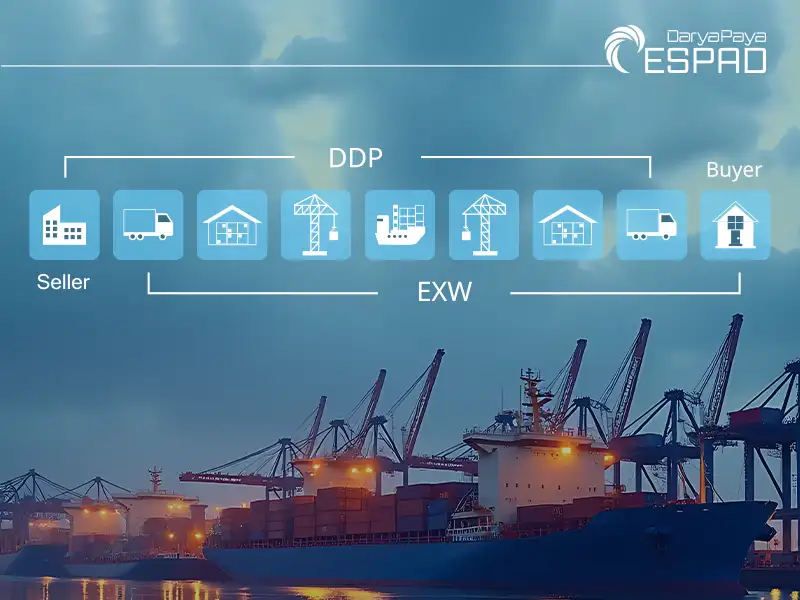
In practical terms, under EXW conditions, the seller is solely obligated to prepare the cargo for collection at the agreed time and location. However, the seller bears no responsibility for loading operations, inland transportation, export customs formalities, international carriage, or cargo insurance. Consequently, the buyer must independently arrange and manage all transportation procedures, beginning with cargo collection at origin and extending through import customs clearance at destination.
This Incoterm is particularly suitable when the buyer possesses extensive access to international freight services, customs brokerage capabilities, and logistical infrastructure, while also preferring to maintain direct operational control over the entire transportation chain.
Responsibilities Under EXW Terms
Although EXW may appear operationally straightforward, its precise allocation of obligations between the seller and the buyer requires meticulous contractual and logistical coordination. Under this rule, the seller’s obligations are minimized, whereas the buyer assumes the maximum level of operational responsibility. Below, we examine the obligations of each party separately.
Seller’s Responsibilities Under EXW Conditions
- Preparing the cargo for delivery at the designated premises (such as the factory or warehouse)
- Packaging the goods appropriately in accordance with the agreed transportation mode (where applicable)
- Notifying the buyer regarding cargo readiness and collection arrangements
- Providing the commercial invoice and any mutually agreed documentation
- Bearing no obligation concerning cargo loading onto the collecting vehicle, export customs clearance, transportation arrangements, or insurance procurement
Important Operational Note:
In practice, many buyers expect the seller to assist at least with loading operations. Therefore, it is strongly recommended that such responsibilities be explicitly stipulated within the commercial contract.
Buyer’s Responsibilities Under EXW Conditions
- Loading the cargo at the seller’s premises
- Performing export and import customs clearance formalities
- Coordinating all domestic and international transportation arrangements
- Paying all freight charges, customs duties, insurance costs, and ancillary logistics expenses
- Assuming all cargo-related risks from the moment the goods are placed at the buyer’s disposal, even prior to loading operations
Advantages and Disadvantages of Utilizing the EXW Term
The utilization of the EXW Incoterm may present multiple operational advantages and disadvantages depending on the commercial position of each contractual party. In this section, we evaluate the strengths and limitations of EXW from both the seller’s and buyer’s perspectives.
Advantages of EXW for the Seller
- Minimal operational responsibility: The seller is only required to prepare the cargo at its own premises without involvement in transportation, customs clearance, or insurance procedures.
- Reduced operational exposure: Risks and liabilities are transferred to the buyer immediately upon cargo availability.
- Greater control over internal resources and scheduling: The seller may focus exclusively on production and cargo preparation without engaging in international logistics procedures.
Disadvantages of EXW for the Seller
- Potential requests for additional operational assistance from buyers: Less experienced buyers may request support beyond the contractual scope of EXW.
- Possibility of contractual disputes: Inadequate documentation or delivery scheduling deficiencies may result in operational disagreements.
Advantages of EXW for the Buyer
- Full operational control over transportation: The buyer may appoint its preferred freight forwarder and maintain comprehensive control over transportation stages, costs, and transit scheduling.
- Enhanced negotiation leverage with logistics providers: Buyers familiar with specific markets may secure more favorable terms from logistics service providers and make more strategically advantageous operational decisions.
Disadvantages of EXW for the Buyer
- Extensive operational and financial risk exposure: All liabilities and transportation risks transfer to the buyer immediately upon cargo availability.
- Requirement for local expertise and infrastructure: In jurisdictions with complex customs procedures, buyers must possess substantial knowledge of local legal and regulatory requirements.
- Hidden costs and increased operational complexity: If the seller fails to cooperate regarding loading operations or documentation provision, the buyer may incur additional costs and procedural complications.
Conclusion and Professional Recommendations
Although the EXW (Ex Works) rule may initially appear simple and cost-efficient, in practice it requires substantial operational expertise, meticulous planning, and comprehensive familiarity with international supply chain management. Under this arrangement, the seller minimizes its obligations by making the cargo available at its premises, while the buyer assumes full responsibility for transportation, customs clearance, loading operations, and insurance coverage.
From a professional operational standpoint, EXW is an appropriate option for sellers seeking to avoid transportation-related liabilities. However, for buyers, this Incoterm is recommended only where sufficient expertise in international transportation and access to reliable freight forwarding networks are available.
Practical Recommendations
- When utilizing EXW conditions, the contract should explicitly specify whether the seller bears responsibility for loading operations, as this remains one of the most disputed interpretational aspects of EXW.
- If you intend to operate under EXW conditions as a buyer, it is highly advisable to engage a reputable freight forwarding company to manage transportation coordination, customs formalities, and international operational follow-up.
- Where familiarity with logistical procedures in the country of origin is limited, utilizing alternatives such as FCA — which offers greater operational flexibility — may constitute a more suitable option.
Ultimately, selecting the appropriate Incoterm depends upon the required level of operational control, the expertise of the contractual parties, and the structure of your international supply chain. Consultation with an experienced logistics provider can play a decisive role in selecting the correct trade term and ensuring the successful execution of international commercial transactions.
For professional consultation and comprehensive international transportation management services, you may collaborate with the specialized team at Espad Darya Paya.