What Types of Cargo Require Special Containers?
An Introduction to Special Containers and the Goods They Carry
Choosing the right container type is one of the most critical decisions in sea freight. Many exporters assume that a standard dry container is suitable for most goods; however, in practice, a wide range of cargo can only be transported safely, economically, and in compliance with international regulations when loaded in a special container. Ignoring this issue may lead to serious cargo damage, disputes with the buyer, port penalties, and even rejection of the cargo at destination.
What Is a Special Container, and Why Is It Mandatory for Some Cargo Types?
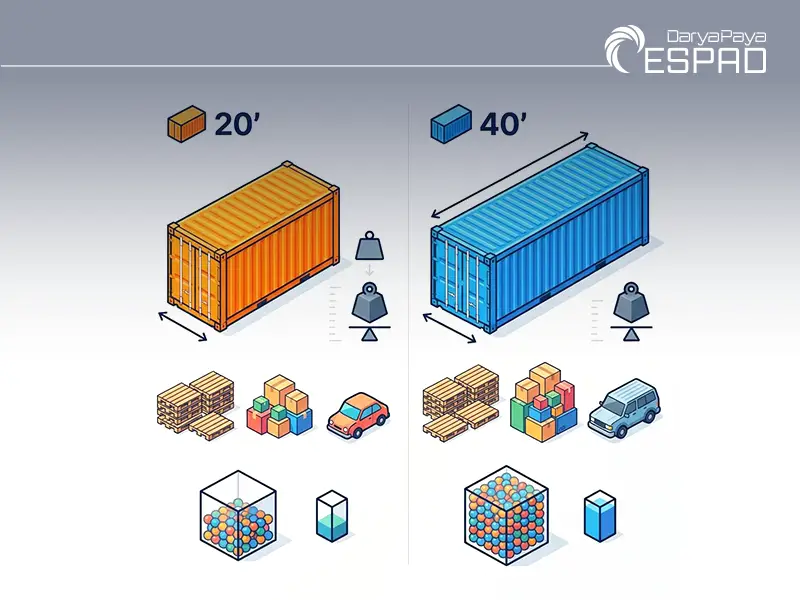
In maritime transport terminology, containers are generally divided into two main categories: general-purpose containers and special containers. Special containers are designed for cargo that is not compatible with a standard dry container due to its physical, chemical, volumetric, or temperature-related characteristics.
Common features of cargo that require special containers include extreme temperature sensitivity, non-standard dimensions, high concentrated weight, hazardous nature, the need for continuous ventilation, or the requirement to be loaded or unloaded from the top or the side. In such cases, using a standard dry container means accepting serious risks in terms of safety, cargo quality, and legal liability.
For exporters in sectors such as petrochemicals, food, agriculture, construction materials, machinery, and chemicals, a precise understanding of special container types and their proper application is a key step in designing a reliable supply chain.
The Main Categories of Special Containers in International Trade
Although many container types exist in the market, from the perspective of practical use, they can be grouped into a few main categories:
- Reefer container
- Open Top container
- Flat Rack container
- ISO Tank container
- Ventilated container
- Roll-on / platform and certain other special types
In the following sections, these categories are reviewed with a focus on what types of cargo require each container and what factors must be considered in selection.
Reefer Container: The Inevitable Choice for Temperature-Sensitive Cargo
The Nature of Reefer Containers and Their Role in Exports
A reefer container is a container that allows temperature control within a defined range. These containers are designed to transport perishable and temperature-sensitive goods from origin to destination in a way that preserves the cold chain as continuously as possible. In international exports, especially in agriculture, food, and pharmaceuticals, reefer containers play a decisive role in maintaining access to regional and global markets.
What Cargo Requires a Reefer Container?
In practice, any cargo for which deviation from the permissible temperature range causes quality loss, spoilage, discoloration, texture change, or a reduction in usable value requires transport in a reefer container. Common examples include:
- Fresh fruits such as apples, kiwifruit, pomegranates, citrus fruits, and dates
- Fresh vegetables and produce in some seasons
- Frozen and semi-frozen protein products
- Dairy products and temperature-sensitive food items
- Certain pharmaceuticals and raw pharmaceutical materials with temperature sensitivity
- Processed food products for which the destination market requires cold-chain transport
Practical Notes for Exporters Using Reefer Containers
Using a reefer container does not simply mean booking a container with cooling capability. Before loading, the exporter must coordinate matters such as the set temperature, permissible temperature range, required humidity, and packaging type with the buyer and, where necessary, with the logistics specialist or cold-chain expert. Correctly recording the Set Point in the container booking, ensuring that power supply can be maintained throughout the route, and carrying out checks before factory-gate departure are among the key points that must not be overlooked.
Open Top Container: For Tall, Voluminous, and Specially Loaded Cargo
Definition and Features of the Open Top Container
An Open Top container is a container without a metal roof, instead covered by a heavy-duty tarpaulin or protective sheet. This design allows loading and unloading from the top and is suitable for goods that cannot be transported in a standard container due to height or loading conditions.
What Cargo Requires an Open Top Container?
A diverse range of goods may require an Open Top container, including:
- Industrial machinery exceeding the standard height of a normal container
- Certain project cargo items such as power plant equipment, large production line components, heat exchangers, and tanks
- Some large glass products, construction equipment, or prefabricated structures
- Cargo that can only be loaded from above by crane and cannot be entered through the container doors
For exporters involved in industrial or EPC projects, a precise understanding of Open Top applications and limitations is especially important.
Practical Considerations in Using an Open Top Container
When using an Open Top container, the exporter must pay special attention to matters such as height restrictions after loading, weight distribution on the container floor, and the packaging and securing method of the cargo. In addition, shipping lines may impose route or capacity restrictions for Open Top containers, and on certain routes different freight rates may apply compared with standard dry containers. This must be reflected in the landed-cost calculation before finalizing the sales contract.
Flat Rack Container: For Overweight and Oversized Cargo
Structure and Function of the Flat Rack
A Flat Rack container is essentially a platform with a reinforced floor and end walls (in some models, collapsible), with no side walls or roof. This design is used for cargo that exceeds the internal dimensions of a standard container in length, width, or height, or that has very heavy concentrated weight.
What Cargo Requires a Flat Rack?
Flat Rack containers are mainly used for the following cargo:
- Construction and mining machinery (loaders, bulldozers, excavators in some sizes)
- Large oil, gas, and petrochemical equipment
- Heavy steel structures, bridge components, and steel frames
- Large tanks, boilers, and certain project cargo items classified as oversized
These types of shipments usually fall under project cargo, and choosing the correct Flat Rack container, together with careful design of securing and packaging, plays a decisive role in preventing damage and movement during transit.
Challenges of Using a Flat Rack
Using a Flat Rack is more complex than using a standard container. In addition to coordinating with the shipping line, the exporter must also review origin-port and destination-port regulations regarding out-of-gauge cargo. Weight distribution on the container floor and port equipment limitations for lifting heavy cargo must also be considered from the outset in project design.
ISO Tank Container: For Liquids and Chemical Materials
Nature and Application of Tank Containers
A tank container is, in fact, an ISO-standard tank installed within a container-like frame structure. This type of container is used for transporting liquids, including chemical liquids, food-grade liquids, and in some cases liquefied gases.
What Cargo Requires an ISO Tank?
Many types of cargo can be transported in tank containers, including:
- Liquid chemical solvents
- Certain liquid polymers and raw materials
- Industrial oils and edible oils in large volumes
- Certain acids and alkalis, subject to dangerous goods classification
- Special grades of chemical products for which drum or IBC packaging is not economically or operationally appropriate
Safety and Legal Considerations in Using Tank Containers
Transporting liquids in a tank container involves not only technical issues but also important legal and insurance implications. The exporter must fully comply with the IMDG Code, packaging requirements, labeling rules, and safety documentation such as MSDS. It is also necessary that the sales contract clearly specify the conditions relating to tank washing, tank return, liability for possible contamination, and hygiene standards for food-grade liquids.
Ventilated Container and Other Special Types for Agricultural and Specialized Cargo
Ventilated Container and Its Application
For certain agricultural products such as green coffee, some types of dried fruit, and goods that require natural ventilation, ventilated containers are used. These containers are equipped with vents that allow air circulation and help prevent moisture accumulation and condensation inside the container.
Although this type of container is not as common as Reefer or Dry containers, it can be a suitable choice in specific cases such as the export of certain dried fruits or moisture-sensitive organic products.
Platform and Other Special Equipment
Some cargo types, especially in project cargo and heavy industry, may require a platform or other special equipment. These cases are usually designed in coordination with a freight forwarder specialized in project cargo.
Comparative Table: Cargo Type and Recommended Container Type
To summarize and provide a quick reference, the table below briefly shows the relationship between certain cargo groups and the recommended container type. Naturally, in each case, a detailed review of the contract, destination regulations, and the technical characteristics of the cargo is essential.
| Main Cargo Group | Export Cargo Characteristics | Recommended Container Type | Key Note for Exporters |
|---|---|---|---|
| Fresh fruits and vegetables | Perishable, sensitive to temperature and humidity | Reefer | Precise agreement on transport temperature, proper packaging, time management |
| Meat, protein products, and dairy | Requires cold chain | Reefer | Compliance with destination-country health and temperature standards |
| Frozen food products | Requires sub-zero temperature | Reefer | Freeze point control and correct set point configuration |
| Tall industrial machinery | Exceeds standard dry container height | Open Top | Crane coordination, route and port height restrictions |
| Oversized project equipment | Exceeds standard dimensions | Flat Rack | Cargo securing design, out-of-gauge review with shipping line |
| Liquid chemicals | Liquid, sometimes hazardous | ISO Tank | IMDG compliance, liability insurance, safety documentation (MSDS) |
| Industrial and edible oils in large volumes | Liquid, high-volume | ISO Tank or Flexi Tank in a Dry container | Economic evaluation between drums, Flexi Tank, and Tank Container |
| Dried fruits and certain agricultural products | Sensitive to moisture and ventilation | Ventilated or modified Dry container | Attention to ventilation, use of liner and desiccant |
| Machinery and extremely heavy structures | Non-standard weight and dimensions | Flat Rack or Platform | Axle load calculation, port and road restrictions |
This table is only a starting point for analysis and does not replace specialized technical and logistics consultation in complex projects.
Common Mistakes Exporters Make in Choosing Special Containers
One of the main causes of cargo damage or disputes between contract parties in sea freight is the incorrect selection of container type. Some of the most common mistakes in this area include:
First, using a Dry container for goods that in practice require a cold chain. At first glance, saving on freight cost may seem attractive, but if the cargo is damaged and rejected at destination or returned, the real cost is far greater than the difference in the container rate. Second, trying to fit bulky and tall cargo into a standard container without considering height and dimensional limitations, which increases the risk of physical damage to the cargo and may also result in refusal at the port or on the vessel.
Another mistake is ignoring dangerous goods classification in the transport of liquid chemicals and selecting an unsuitable container without considering IMDG requirements. In addition to safety risks, this can create serious legal and insurance consequences for the exporter. Also, some exporters use special containers for large projects without consulting a specialized freight forwarder and then face unforeseen operational limitations during execution.
Contractual and Risk Considerations in Choosing a Special Container
Choosing a special container is not only a technical decision; contractual and risk-related dimensions are also fully involved. When drafting the sales contract, especially under Incoterms rules, it must be specified which party is responsible for selecting the container type and the related obligations. For example, under rules such as CIF or CFR, if the seller is responsible for sea carriage, the container type, temperature conditions, and special carriage requirements must be clearly stated in the contract.
In addition, including clauses related to cargo acceptance at destination, the obligation to provide temperature records (in the case of Reefer containers), and the handling of losses resulting from incorrect container selection can play a key role in fair dispute resolution. A professional exporter usually consults with its logistics department and transport advisor before finalizing the contract so that potential risks are properly identified and managed.
Practical Recommendations for Exporters in Choosing the Right Container
Although each export case has its own specific conditions, several general principles can help exporters choose the correct container.
First, the cargo type must be analyzed beyond its general category. For example, “petrochemicals” or “food products” are very broad classifications, and each subgroup may have completely different requirements in terms of temperature, ventilation, chemical risk, or physical sensitivity. Second, the transport route, the capabilities of the origin port, the destination port, and the restrictions of the shipping lines on the intended route must always be reviewed.
Another important point is attention to the landed cost. In some cases, using a special container may appear more expensive at first glance, but when the cost of risk, potential damage, penalties, and possible delays is included in the equation, it may in fact be the more economical option. In addition, precise documentation of transport conditions, including container type, set temperature, seal status, and packaging method, helps reduce potential disputes with the buyer.
Finally, maintaining ongoing communication with freight forwarders and shipping lines active on international routes, and benefiting from their experience in similar projects, can help the exporter choose the right combination of safety, cost, and speed for each shipment.
Choosing a Special Container Is a Strategic Decision, Not Just an Operational One
The answer to the question “What types of cargo require special containers?” cannot be reduced to a few simple examples. The reality is that any cargo that falls outside the standard limits of a dry container in terms of temperature, dimensions, weight, chemical nature, or loading conditions becomes a candidate for special container use. For exporters, especially in an environment where international competition and sensitivity to delivery quality are constantly increasing, a professional approach to this issue is a necessity, not an optional choice.
A company that properly uses reefer containers for perishable goods, books flat racks or open tops in time for project cargo, and uses ISO tanks in accordance with standards for liquid chemicals, is not only reducing operational risks in practice, but also sending the buyer a clear message that it is dealing with a professional and reliable partner. This level of professionalism in container selection, combined with competitive pricing and compliance with commitments, can become one of the sustainable advantages of an export business in target markets.
If container selection is viewed as part of the design of the entire supply chain rather than merely an execution step on the day of loading, then many of the challenges exporters face at origin and destination ports can be prevented from the outset. In this view, a special container is not an extra cost, but a tool for protecting export value and brand reputation in global markets.
Espad Darya; a Leading Choice in International Sea and Container Shipping
Espad Darya Shipping, drawing on operational experience, a broad network of cooperation, and a professional approach to transport chain management, is recognized as one of the leading options for sea freight and container transport on international routes. By providing reliable, organized, and cargo-owner-oriented solutions, the company seeks to execute the transport process from origin to destination with the highest level of precision, safety, and transparency. Espad Darya’s focus on service quality, schedule compliance, and specialized support has made it a trusted choice for exporters, importers, and international trade professionals.