How Can You Avoid Overcharge in Sea Freight?
In the complex and highly competitive world of sea freight, precise management of cargo weight and volume is not only a technical and legal requirement, but also has a direct impact on profitability and supply chain efficiency. One of the most common challenges in this field is overcharge. Shipping lines, ports, and freight companies each have their own standards and limitations for cargo weight and dimensions. Ignoring these limits not only creates direct costs for the shipper or consignee, but also negatively affects overall operational efficiency.
In this article, we examine the various factors affecting overcharge, how it is calculated, and how to manage these costs intelligently. To learn how to avoid these charges and optimize sea freight costs, read on.
How Is Sea Freight Cost Calculated?
Sea freight cost calculation depends on multiple factors, each of which can directly or indirectly affect the final transportation price. Contrary to common belief, freight cost is not limited to the shipping line’s base rate; rather, it includes a range of main and ancillary charges, the most important of which are:
Cargo weight and volume: In sea freight, charges are calculated based on the actual weight or the volumetric weight of the cargo, and some shipping lines charge according to the greater of the two.
- Cargo type: Goods with special characteristics, such as hazardous or perishable cargo, or cargo requiring special conditions such as temperature control, usually incur higher costs.
- Container type: Freight charges vary depending on the type of container used, such as 20-foot, 40-foot, reefer, flat rack, and so on, with special containers costing more.
- Transport distance and route: The distance between origin and destination, as well as the transport method (direct or multimodal), has a direct effect on costs.
- Port and customs charges: Costs such as loading, unloading, storage, and customs services at the origin and destination ports can increase sea freight expenses.
- Fuel and exchange-rate fluctuations: Changes in fuel prices and currency exchange rates can lead to higher costs.
- Additional services: If extra services such as packing, sealing, insurance, or door-to-door delivery are required, these will increase the final freight cost.
What Is Overcharge in Sea Freight?
In sea freight, each container or shipment is transported based on the weight and volume limits set by shipping lines. When the cargo weight or volume exceeds these permitted thresholds, overcharge occurs, which is determined based on two factors: weight and volume.
What Is Overweight?
Overweight occurs when the gross weight of the shipment exceeds the permitted weight of the container or vessel. For example, a standard 20-foot container has an approximate gross weight capacity of 24 tonnes. If the combined weight of the cargo and container exceeds this amount, it is considered overweight.
What Is Oversize?
When the physical dimensions of the cargo—length, width, or height—exceed the internal dimensions of the container, the shipment is considered oversize. In such cases, special containers such as Flat Rack or Open Top must be used, which are significantly more expensive than standard containers.
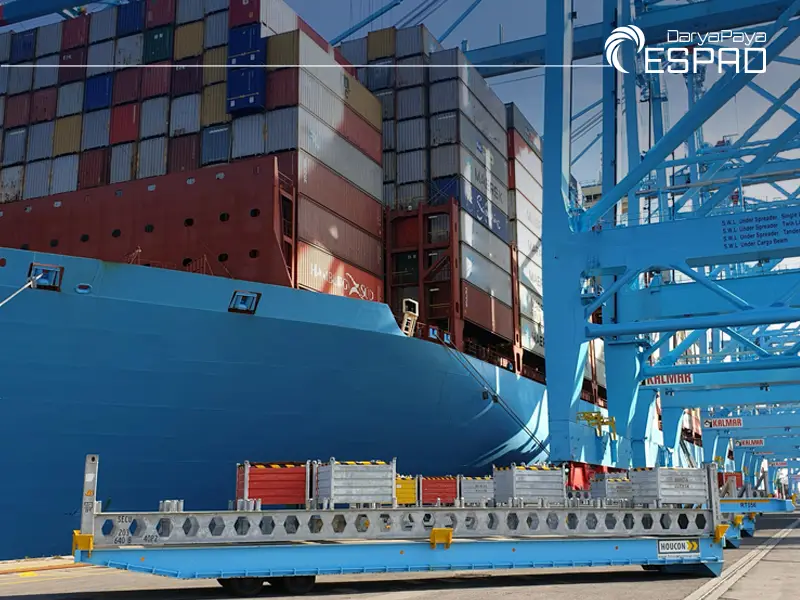
Charges Related to Overcharge in Sea Freight
When a shipment exceeds the permitted weight or volume, it not only faces technical and safety restrictions, but also imposes additional and sometimes significant costs on the cargo owner. These charges vary depending on the degree of overcharge, the shipping route, the container type, and the shipping line’s regulations, but they can generally be classified into the following categories:
1. Overcharge penalty imposed by shipping lines
Most shipping lines apply a specific surcharge for cargo that exceeds the container’s permitted weight—usually around 30,480 kg for a 40-foot container. These charges are generally calculated as a fixed amount per tonne of excess weight.
2. Cost of using special containers
If the cargo dimensions or weight exceed standard capacity, it cannot be transported in a conventional container. In this case, you will need special containers such as Flat Rack, Open Top, or Breakbulk, whose rental and transport costs are significantly higher.
3. Higher port charges
Heavier or bulkier cargo usually requires specialized equipment, more manpower, or special loading and unloading procedures. This results in increased port charges.
4. Land transport costs and movement permits
In cases where overcharge cargo is moved by road after leaving the port, permits for heavy or oversized cargo (Oversize/Overweight Permits) may be required. Land transport rates also increase for such cargo.
5. Higher insurance premiums
Overcharge cargo creates greater risk for the goods, the container, and the transport equipment. For this reason, insurers usually apply higher premiums for such shipments.
How to Calculate Overcharge in Sea Freight
To manage costs correctly and avoid possible penalties, it is essential to understand how overcharge is calculated in sea freight. Overcharge may arise from excessive weight or dimensions beyond the permissible limit, and shipping lines use specific methods to calculate the related charges, which are explained below.
1. Calculating Overweight
Overweight is calculated when the gross weight of the cargo plus the container exceeds the permissible weight defined by the shipping line.
For example:
- The maximum permitted weight of a 40-foot container is 30,480 kg.
- If the cargo weight plus the container weight equals 33,000 kg, then the shipment has 2,520 kg of overweight.
In this case, the shipping line usually adds a fixed amount to the base freight rate for every 1,000 kg of excess weight.
It should be noted that some routes or ports enforce stricter limitations and may refuse overweight cargo or apply much higher charges.
2. Calculating Oversize
If the cargo dimensions (length, width, or height) exceed the internal dimensions of the container, a standard container can no longer be used, and the cargo is treated as an oversized shipment, which increases transport costs.
For oversize cargo, Flat Rack or Open Top containers are used, and their freight rates are determined based on the actual cargo dimensions (length×width×height)(\text{length} \times \text{width} \times \text{height}).
Some sea freight companies calculate oversize charges as a percentage of the base freight rate—for example, 20% to 50% more.
3. Calculating Volumetric Weight
In some cases, especially for light but bulky cargo, freight charges may be calculated not on the basis of actual weight, but on volumetric weight. If the volumetric weight exceeds the actual weight, the volumetric weight is used as the basis for charging. The formula for calculating volumetric weight is as follows:
Volumetric Weight=Length (cm)×Width (cm)×Height (cm)6000 \text{Volumetric Weight} = \frac{\text{Length (cm)} \times \text{Width (cm)} \times \text{Height (cm)}}{6000}
How Can You Avoid Overcharge Costs in Sea Freight?
Overcharge is one of the most common challenges in sea freight and can lead to significantly higher costs, shipping delays, and even cargo rejection. Fortunately, by following a few simple and professional principles, this issue can be largely avoided. Key measures to reduce overcharge costs in sea freight include:
- Accurate measurement of cargo weight and dimensions
- Using the right container
- Consulting experienced freight companies
- Paying attention to route and port limitations
- Comparing costs and calculating charges before shipment
Smart Cost Management in Sea Freight
In the highly competitive world of international trade, controlling and managing transport costs—especially in the maritime sector—plays a key role in maintaining profitability and supply chain efficiency. One of the most important of these costs is overcharge-related expense; if not properly managed, it can impose hidden but substantial costs on a business.
Whether caused by weight exceeding the permitted limit or by non-standard dimensions, overcharge can lead to expenses such as shipping line penalties, special container rental, higher insurance premiums, specialized loading and unloading charges, and even increased inland transport rates. By taking simple and informed actions such as accurately weighing cargo, selecting the right container, consulting transport specialists, and carefully reviewing shipping line and port regulations, these additional costs can be avoided.
To prevent unexpected costs caused by overcharge and to choose the best transport solutions, you can benefit from the expert consultation of Espad Darya Paya. Our team provides the best options based on your needs to reduce costs and accelerate the shipping process.