What Is CBM and How Is It Calculated in Container Shipping?
In international trade, one of the key factors in transport planning and freight cost estimation is determining the actual cargo volume, commonly referred to as CBM (Cubic Meter). CBM is the unit that indicates how much space a shipment occupies inside a container, and on this basis, freight charges are calculated in transport modes such as sea, air, and road freight.
Particularly in containerized transportation, understanding how to calculate CBM not only helps reduce costs, but also plays an effective role in selecting the appropriate container type, avoiding unnecessary dead space, and expediting customs-related processes. For traders, freight forwarding companies, and exporters, this is considered a professional necessity. Below, we explain in greater detail what CBM is and how it is calculated.
How to Calculate CBM
CBM calculation in container shipping is one of the fundamental principles of logistics and international transportation. This unit is used to measure cargo volume and plays an important role in sea, air, and road transport for determining the space occupied by the shipment and estimating freight costs. Below, you will find the main formulas used for CBM calculation:
1. Basic Formula for Calculating CBM
To calculate CBM, if the cargo dimensions are in meters, the following formula is used:
Volume (CBM) = Length (m) × Width (m) × Height (m)
If the cargo dimensions are given in centimeters, each dimension must first be divided by 100 in order to convert it into meters.
2. Calculating CBM for Multiple Packages
If you have several packages with identical shape and dimensions, the CBM is calculated using the following formula:
Total Volume (CBM) = Volume of One Package × Number of Packages
For example, if one carton measures 50 cm × 40 cm × 60 cm,
the figures must first be converted into meters:
Length = 0.5 m
Width = 0.4 m
Height = 0.6 m
Then the volume of one carton is calculated as follows:
0.5 × 0.4 × 0.6 = 0.12 CBM
If you have 100 cartons:
0.12 × 100 = 12 CBM
3. CBM in Ocean Freight (FCL and LCL)
In containerized sea freight, two common loading arrangements are used:
FCL (Full Container Load): The entire container is booked by one shipper, and the freight is calculated based on the container type.
LCL (Less than Container Load): Your cargo is consolidated with other shipments in one container. In this case, freight is usually calculated based on CBM or weight, whichever is greater.
4. Weight-versus-Volume Rule in LCL Ocean Freight
For LCL cargo, the following rule generally applies:
If 1 cubic meter weighs less than 1,000 kilograms, freight charges are calculated based on volume (CBM).
If 1 cubic meter weighs more than 1,000 kilograms, freight charges are calculated based on the actual gross weight.
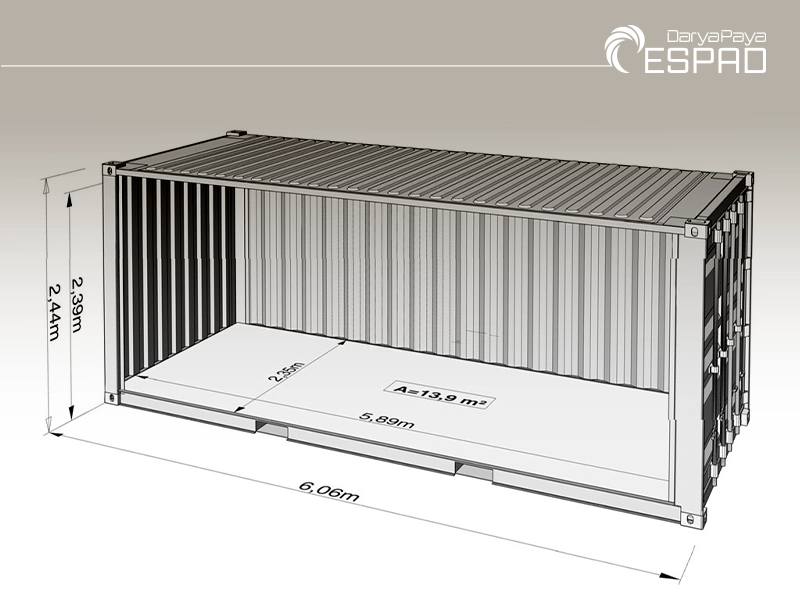
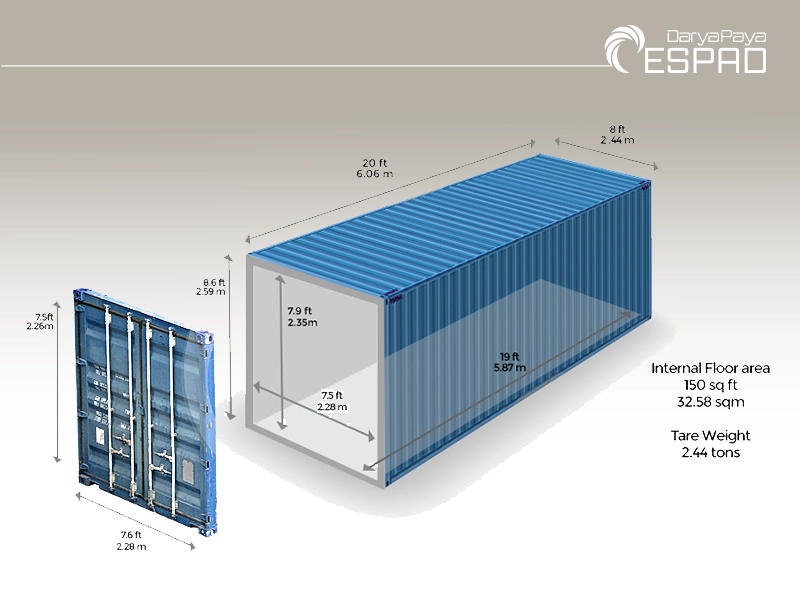
Approximate Container Capacity in Terms of CBM
| Container Type | Approximate Capacity in Cubic Meters (CBM) |
|---|---|
| 20-foot Standard Container | 28 to 33 CBM |
| 40-foot Standard Container | 58 to 66 CBM |
| 40-foot High Cube Container | 65 to 76 CBM |
Important Points in CBM Calculation
The calculation does not include only the dimensions of the cargo itself; the dimensions of the packaging must also be taken into account.
For palletized cargo or irregularly shaped shipments, the actual occupied space must be considered.
In air freight, the volumetric weight formula is usually applied; however, CBM calculation still remains important for preliminary freight estimation.
The Specialized Role of Espad International Shipping in CBM Calculation
CBM calculation in container shipping not only helps ensure accurate freight costing, but also plays an important role in container selection, load optimization, and the prevention of hidden charges. In the world of international trade, where competition and timing are decisive factors, familiarity with this concept is essential for cargo owners and trading companies. By leveraging specialized industry experience together with precise measuring and packaging systems, Espad Shipping provides professional services in CBM calculation, transport consultancy, and the selection of the most efficient logistics routes, serving as a reliable partner throughout the international cargo transportation process.