What Is the FOB Term and How Does It Affect Shipping Contracts?
In international trade, the responsibilities of the seller and the buyer must be clearly defined. Who handles export customs clearance? Who is responsible for cargo insurance? Who pays for transportation costs?
The FOB term answers these questions. In this article, we explain what FOB (Free On Board) means and how it influences logistics and shipping contracts in international business.
What Is FOB?
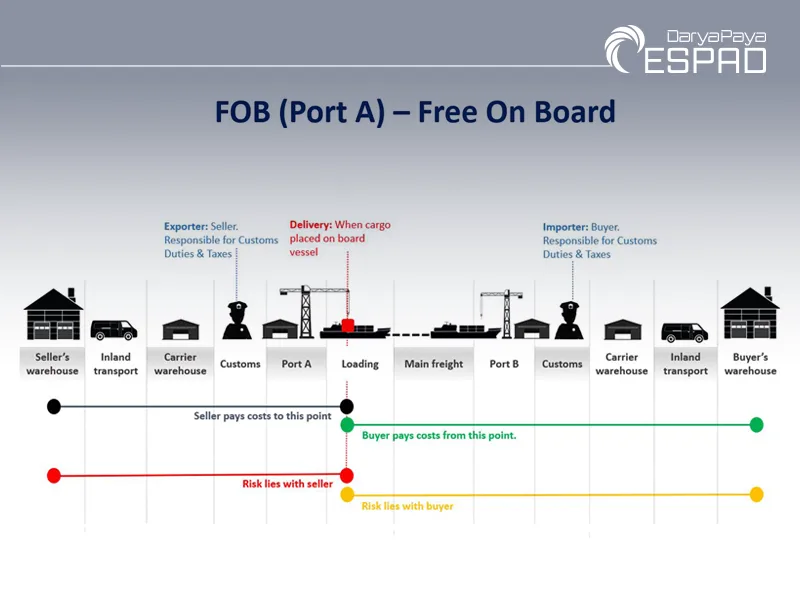
FOB (Free On Board) is one of the Incoterms® 2020 rules used exclusively in maritime and inland waterway transport. It defines the delivery point as on board the vessel at the port of shipment.
In simple terms, FOB means that the seller delivers the goods onto the vessel designated by the buyer at the agreed loading port.
Under FOB rules, the seller must complete export customs clearance and load the cargo onto the vessel. Once the goods are placed on board, the risk, responsibility, and further costs transfer to the buyer.
From that point forward, all expenses related to the shipment—including international freight charges, insurance (if required), unloading at the destination port (if agreed), and import duties—are the responsibility of the buyer.
It is important to note that FOB does not transfer ownership of the goods. It only determines when the risk of loss or damage transfers from the seller to the buyer.
For example, if a contract states “FOB Bandar Abbas”, the seller must deliver the goods onto a vessel in Bandar Abbas port. From that moment onward, all responsibilities and costs until the cargo reaches the destination port (for example, Mumbai) belong to the buyer.
Seller and Buyer Responsibilities Under FOB
The Incoterms FOB rule clearly defines the obligations of both parties.
Seller’s Responsibilities
- Packaging and labeling the goods according to international standards
- Completing export customs clearance and obtaining required permits
- Paying transportation costs from the production site to the port of shipment
- Loading the goods onto the vessel at the agreed time and port
- Providing the necessary shipping documents to the buyer
Buyer’s Responsibilities
- Paying for the goods according to the commercial invoice
- Accepting the goods on board the vessel at the agreed time and location
- Choosing the shipping method and arranging insurance (if required)
- Paying for ocean freight, insurance, unloading at the destination port, and inland transport

Advantages of FOB Shipping
As mentioned earlier, the FOB contract clearly defines the responsibilities of the buyer and seller, reducing misunderstandings in international trade agreements.
This Incoterm offers benefits for both parties:
For the seller, responsibility ends once the goods are loaded onto the vessel. The seller is not responsible for insurance, international freight risks, or transportation costs beyond the port of shipment.
For the buyer, FOB provides greater flexibility in selecting a shipping company, negotiating freight rates, and managing logistics costs. Buyers can choose a freight forwarder offering better pricing or higher service quality. This flexibility can improve operational efficiency and reduce overall supply chain costs.
Are There Any Drawbacks to FOB?
Despite its advantages, the FOB rule also comes with certain challenges.
One of the main issues is that risk transfers to the buyer very quickly—as soon as the cargo is loaded onto the vessel. If the buyer lacks sufficient experience in logistics or chooses an unreliable shipping provider, this could result in significant financial or operational losses.
Additionally, disputes can sometimes arise regarding the exact timing or location of risk transfer.
For this reason, especially for less experienced buyers, choosing the right logistics partner and fully understanding contractual obligations is crucial when using FOB terms.
FOB vs. CIF: What’s the Difference?
Another commonly used Incoterm is CIF (Cost, Insurance and Freight). Like FOB, it defines responsibilities between the buyer and seller.
The main differences between FOB and CIF involve risk transfer, freight payment, and insurance coverage.
Under FOB, the seller delivers the goods on board the vessel at the port of shipment. After loading, all risks and costs—including freight, insurance, and potential cargo damage—transfer to the buyer.
Under CIF, however, the seller must arrange and pay for transportation and insurance until the cargo reaches the destination port. This means the seller remains responsible for freight and insurance coverage during the main sea voyage.
Other Important Incoterms
Besides FOB and CIF, several other Incoterms are widely used in international trade:
EXW (Ex Works)
The seller has minimal responsibility. Goods are made available at the seller’s premises (factory, warehouse, etc.), and the buyer assumes all costs and risks from that point onward.
FCA (Free Carrier)
The seller delivers the goods to a carrier appointed by the buyer at a specified location. After delivery to the carrier, responsibility transfers to the buyer. This term is commonly used in multimodal transport.
CFR (Cost and Freight)
The seller pays the cost of transporting goods to the destination port, but risk transfers to the buyer once the goods are loaded onto the vessel.
Choosing the Right Shipping Company for FOB Contracts
FOB is a powerful Incoterm that helps clarify responsibilities and costs in maritime shipping contracts. However, successful implementation of FOB largely depends on selecting a reliable and experienced shipping company.
Working with logistics providers that specialize in international transportation can significantly reduce shipping risks and ensure the smooth execution of contractual obligations.
With years of experience in maritime shipping and international logistics, Espad Darya can serve as a trusted partner for businesses. For professional consultation and customized logistics solutions tailored to your cargo needs, you can contact the company’s specialists.