A Practical Guide for Managing Sea Freight to Iran During Wartime Conditions
Amid the current high‑risk environment affecting maritime transport across the region, the global supply chain has effectively entered a mode similar to crisis‑level logistics management. Restrictions on key shipping lanes, significant increases in war‑risk–related costs, and reduced operational capacity at several ports have made traditional planning models unreliable. In many cases, standard freight assumptions simply no longer apply.
The following report is based on real‑world observations and operational experience gathered by Espad. It aims to give international shippers, freight forwarders, and exporters a clear and practical understanding of what is happening right now—and what decisions are necessary to maintain stable cargo flows to Iran during high‑risk periods.
Reality 1: Significant Increase in War Risk Costs—Often Exceeding USD 1,000 per TEU
War‑risk surcharges have now become a major defining component of total shipping costs in most regional lanes. In many cases, these surcharges represent a substantial portion of the overall freight rate.
Across international markets, many carriers have introduced War Risk Surcharges (WRS) in the range of up to USD 1,500 per TEU. When combined with additional insurance charges and regional security‑related costs, the total can rise to USD 2,000–4,000 per container on certain routes.
In Iran‑related services, and based on the announcement of the Iranian Shipping Association, an operational war‑risk figure of around USD 1,000 per TEU has been widely applied and is now integrated into freight rate calculations.
As a result, estimating freight costs without including a war‑risk component is no longer accurate. Rates that were previously used as a benchmark are now outdated. Price quotations should be requested frequently—often daily, and in some cases for each shipment individually.
Reality 2: Service Disruptions and Longer Transit Times
Rising geopolitical tensions in the region have significantly altered the structure of maritime services. Many carriers have reduced or suspended direct sailings, particularly on lanes entering or passing near high‑risk areas.
Access through certain sensitive routes—especially the Strait of Hormuz—has become restricted or temporarily halted at times.
As a result:
- A considerable number of vessels are being rerouted through longer alternatives
- Carriers increasingly rely on intermediate or transshipment ports
- Transit times on multiple lanes have increased
- ETA reliability has decreased, with higher levels of schedule deviation
Given these changes, logistics planning now requires continuous monitoring of service updates and constant adjustment of timelines.
Reality 3: Delays in Port Operations and Terminal Handling
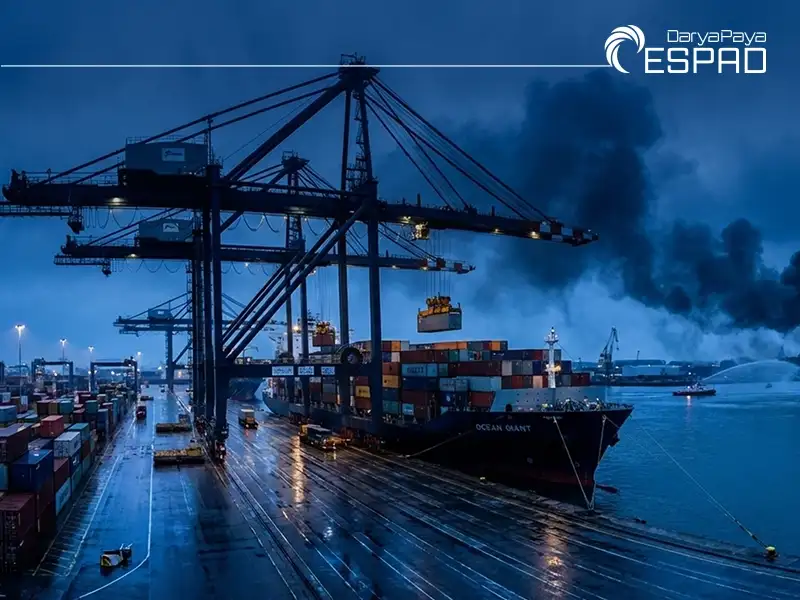
Beyond shipping routes themselves, port‑side operations have also slowed down. In several regional ports, operational work hours have been reduced due to safety considerations and local authorities’ restrictions. The number of active shifts has also been limited.
Furthermore, with many vessels rerouted to alternative ports, congestion has increased:
- More ships arriving simultaneously
- Higher container accumulation in yards
- Longer waiting times for berthing, unloading, and loading
Globally, multiple warnings have been issued regarding the risk of severe port congestion resulting from widespread rerouting.
Therefore, current delays are not only tied to transit times but also to port‑side inefficiencies. Realistic logistics planning must now include extended dwell times at ports. In practice, the actual lead time is a combination of transit duration plus port waiting time.
How Espad Supports International Shippers in These Conditions
With volatility and uncertainty increasing across the maritime market, Espad has shifted its operational strategy from simple freight execution to scenario‑based freight management. This approach gives customers a clearer view of possible options and allows for more informed decision‑making.
1. Designing Multiple Scenarios for Each Shipment
For every shipment, Espad typically evaluates two to three alternative routes, assessing:
- Actual expected transit time, including potential port delays
- Accurate cost estimation
- The risk level associated with each routing option
2. Continuous Cost Updates
Given the rapid changes in market conditions:
- Long‑term fixed rates are not feasible
- Quotes reflect current market reality
- Surcharges and additional costs are clearly itemized
3. Time Planning Based on Operational Realities
Relying solely on carriers’ published schedules is no longer practical. Espad includes:
- Port operational conditions in all time calculations
- Time scenarios adjusted based on real‑world execution
4. Helping Customers Reduce Decision‑Making Risk
Espad is not simply a freight rate provider. By offering operational analysis, the company helps:
- Clarify the risks of each route or shipping scenario
- Enable transparent comparison of options
- Support smarter operational decisions
Practical Recommendations from Espad for International Shippers
To better manage risks and costs in the current environment, the following measures are strongly recommended:
1. Book Earlier Than Usual
- Place bookings 10–14 days earlier than normal
- Many services reach full capacity faster than before
2. Accept Higher Costs as a Structural Reality
- War‑risk charges are now part of the core cost structure
- For exporters, this may require reviewing product pricing models
3. Plan for Longer Timelines
- Avoid overly optimistic transit assumptions
- Always include potential port delays in planning
4. Use Multiple Shipping Scenarios Instead of Relying on One Route
- Dependence on a single carrier or lane increases operational risk
- Always maintain a backup option (Plan B)
5. Increase Safety Stock Levels
- Supply chain delays are likely
- Low inventory levels may expose companies to operational shutdowns
Decisions That Increase Risk in the Current Environment
Certain choices can significantly increase costs or disrupt shipment plans, including:
- Relying on outdated freight rates
- Choosing the lowest price without assessing operational risk
- Late booking and missing vessel capacity
- Ignoring port waiting times
- Over‑reliance on one route or one shipping line
The Maritime Market Has Entered a New Phase
In the current situation:
- Costs have structurally increased (often around USD 1,000 per TEU minimum war‑risk impact)
- Transit times are longer and less predictable
- Port operations face more restrictions and delays
Competitive advantage is no longer simply about achieving the lowest rate—it now depends on:
- Better scenario planning
- Faster and more informed decision‑making
- Professional risk management in the supply chain
Espad has expanded its role from a logistics operator to a supply‑chain operations advisor, helping international shippers maintain cargo flow even when multiple routes are partially or fully disrupted.
If you are planning a shipment to Iran, the decisions you make today will directly affect your costs and delivery timetable in the coming weeks.